

NASA's Voyager 1 reaches 16 billion-mile record: One Light Day from Earth
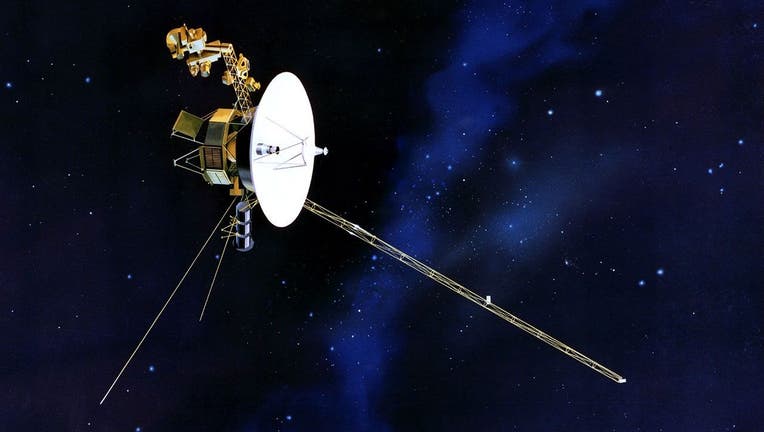
This is an artist's concept of NASA's Voyager spacecraft with its antenna pointing to Earth. Image Credit: NASA/JPL
NASA's Voyager 1 spacecraft hit a major milestone in deep space on Wednesday morning – traveling one Light Day from Earth (or 16 billion miles away), and continuing its record of being the most-distance human-made object in space. Voyager 1 was expected to hit its milestone mark at 5:16:07 a.m. on Nov. 18, 2026.
What we know about Voyager 1
The backstory:
NASA's Voyager 1 launched into space in September 1977, destined to explore and capture images and data of Jupiter and Saturn, and then on to interstellar space. Voyager 1 launched two weeks after Voyager 2, it's sister spacecraft with a similar mission, but took a faster approach towards Jupiter and Saturn, and deep space, NASA said.
What is a Light Day?
By the numbers:
A Light Day refers to the distance that a light particle can travel in 24 hours, which equals 16,094,799,096 miles, NASA said, adding that nothing travels faster than light.
Here are some other ways to look at that:
- Light travels through space at 186,000 miles every second
- A light-year refers to how far light can travel in a year, which is 5.88 trillion miles
- The closest neighboring solar system to our own, the star Proxima Centauri, is roughly 4.24 light-years away. That's 24.95 trillion miles.
Artemis II's astronauts took three days to travel 238,000 miles from Earth to the moon, NASA said. Light, however, can travel that distance in 1.3 seconds.
Voyager 1 mission milestones
Timeline:
- September 5, 1977: Voyager 1 launches into space
- March 5, 1979: Jupiter flyby - closest approach
- Nov. 12, 1980: Saturn flyby - closest approach
- Feb.17, 1998: Became the most distant human-made object after overtaking NASA's Pioneer 10
- Jan. 1, 1990: Voyager Interstellar Mission (VIM) officially began
- Aug. 16, 2006: 100 astronomical units reached
- August 2012: Voyager 1 enters interstellar space
Voyager 1's new mission
What's next:
According to NASA's website, Voyager 1 is headed towards a star in deep space, called AC +79 3888 or Gliese 445, which is more than 17 light years from Earth.
"It’s an obscure star now in the constellation Ursa Minor (the Little Bear or Little Dipper), and Voyager 1 is expected to pass within about 1.7 light-years of it — in 40,000 years. Even though the spacecraft, in flight since 1977, is cruising at nearly 38,000 mph (61,000 kph) through the vacuum of space, that’s a relative crawl compared to the speed of light," NASA said.
Track NASA's Voyager 1 live
Some of Voyager 1's space discoveries
Dig deeper:
Voyager 1 has been flying through space for 50 years. Here are some of its discoveries, according to NASA:
- Discovered a thin ring around Jupiter and two new Jovian moons: Thebe and Metis.
- At Saturn, Voyager 1 found five new moons and a new ring called the G-ring.
- Voyager 1 was the first spacecraft to cross the heliosphere, the boundary where the influences from outside our solar system are stronger than those from our Sun.
- Voyager 1 is the first human-made object to venture into interstellar space.
Other milestones (via NASA):
- Feb. 17, 1998, Voyager 1 became the most distant human-made object in existence when — at a distance of 69.4 AU from the Sun — it "overtook" Pioneer 10.
- Dec. 16, 2004, Voyager 1 reached the termination shock and entered the heliosheath.
- Aug. 25, 2012, the spacecraft became the first to exit the heliosphere and begin measuring the interstellar environment.
The Source: This story uses information, timelines, articles, and key dates from NASA's web pages on Voyager 1, Voyager 2, and its "Light Day" milestone. Reported from Orlando.