

Trump’s new tariffs already face 2 lawsuits from small businesses
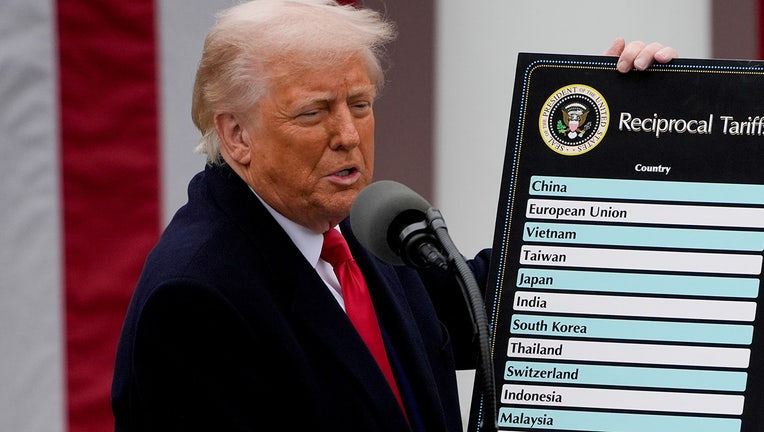
US President Donald Trump holds a reciprocal tariffs poster during a tariff announcement in the Rose Garden of the White House in Washington, DC, US, on Wednesday, April 2, 2025. Photographer: Kent Nishimura/Bloomberg via Getty Images
The latest round of tariffs revealed by the White House this week already faces a pair of legal challenges. Several small businesses have filed lawsuits over the hikes, which extended to dozens of countries and were set to go into effect as previous tariffs expired on Friday.
Big picture view:
In one of the lawsuits, a company that already defeated the Trump administration in a tariff case, Learning Resources, is part of a group of small businesses to file a lawsuit in the Court of International Trade.
Meanwhile, New York-based spice company Burlap and Barrel and watch retailer Collective Horology are represented by the libertarian advocacy group Liberty Justice Center in a separate lawsuit.
RELATED: Civil rights groups sue HHS for cutting child care, family assistance
What they're saying:
The two lawsuits make a similar argument. The plaintiffs contend the Trump administration does not make a case against a specific economy, nor does it detail how the tariffs would affect the government’s stated reason: that the affected countries have not done enough to curb forced labor.
"Forced labor is morally indefensible, but an important objective does not give the government permission to ignore the law," said Sara Albrecht, chairman and CEO of the Liberty Justice Center. "The administration allowed one global tariff to expire and immediately replaced it with another under a different statute. Changing the statute doesn’t change the law."
The other side:
The White House did not immediately respond to an Associated Press request for comment after the lawsuits were filed. However, it stated its reasons on Thursday when the tariffs were announced.
RELATED: Map: 24 states sue Trump administration over FEMA disaster funding
"The United States has had a forced labor import ban for nearly a century, and rigorously enforces it; it’s well past time for our trading partners to do the same," said U.S. Trade Representative Jamieson Greer.
By the numbers:
According to the White House, the tariffs will range from 10% to 12.5% and apply to 60 trading partners. Those nations account for 99% of U.S. imports. Canada, the European Union, Mexico and Taiwan are among the countries facing 10% tariffs, while China, Japan, South Korea, and multiple other nations are being hit with the higher 12.5% tariff.
What's next:
While Learning Resources has defeated the Trump administration once, the educational toy company, along with other plaintiffs, faces a tougher hill to climb with these lawsuits, according to experts. Other previous lawsuits over separate tariffs on China that utilized the same provision as the one used by the White House this time, Section 301, survived a Supreme Court challenge.
The Source: Information for this article was taken from The Associated Press. This story was reported from Orlando.