

Houston Proposition A passes: HPD preparing for policy changes, effective date still unclear
Houston voters approve no-knock warrant ban, deprioritizing marijuana
Houston voters approved Proposition A, also known as the Houston Freedom Act, addressing misdemeanor marijuana enforcement and no-knock search warrants. FOX 26's Karys Belger explains the new rules, why the proposition was on the ballot, and the mayor's response.
HOUSTON - Houston police will work toward implementing required policy changes and necessary training before the voter-approved Houston Freedom Act takes effect, according to Mayor John Whitmire’s office. But the city has not yet confirmed when that will happen.
What is Houston's Proposition A?
Big picture view:
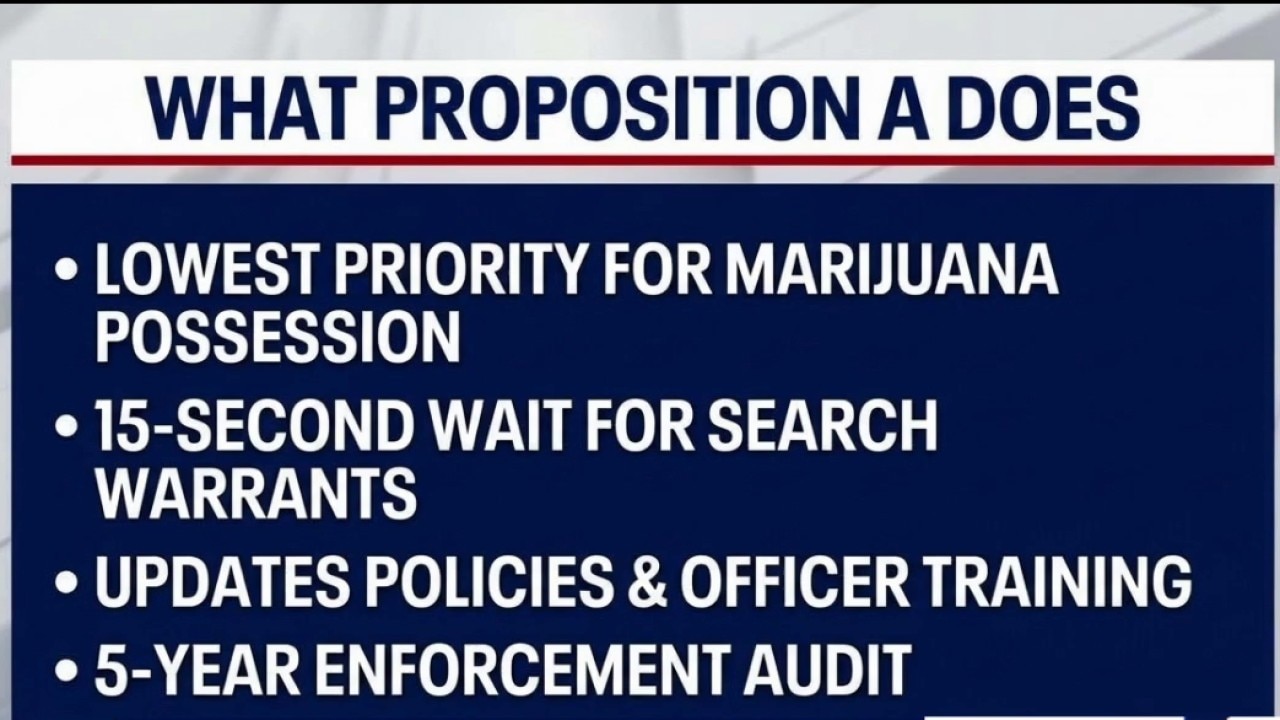
Voters approved Proposition A, a city charter amendment that makes Class A and Class B misdemeanor marijuana possession the Houston Police Department’s lowest enforcement priority and prohibits officers from requesting, executing or participating in search warrants that do not require officers to knock, announce their presence and wait at least 15 seconds.
The amendment also requires updated operating procedures, officer training, a review of five years of misdemeanor marijuana enforcement and ongoing public reporting.
Response from Mayor's Office, HPD
What they're saying:
In a written response to FOX 26, Álvaro Ortiz with the mayor’s Office of Communications said HPD would prepare for the amendment before its effective date.
"In response to your inquiry, the Houston Police Department (HPD) will work toward implementing any required policy changes and toward any necessary and pertinent training prior to the amendment going into effect," Ortiz wrote. "As for the effective date, I am still gathering this information."
The response did not include a training schedule, copies of revised policies or the specific instructions officers will receive.
HPD separately told FOX 26 that the department follows the law, declined further comment and referred questions to whoever issued the charter amendment notice.
FOX 26 also contacted the City Secretary’s office seeking clarification about the effective date and the formal steps needed following the vote.
What Proposition A says about no-knock warrants
Dig deeper:
The amendment establishes restrictions on the search warrants Houston police officers may request or help execute.
Under its language, officers cannot request, execute or participate in the execution of a search warrant that does not require them to:
- Knock.
- Announce their presence.
- Wait at least 15 seconds before executing the warrant.
The provision applies specifically to search warrants. It should not be read as a description of every circumstance in which police might enter a property.
Natalie Marquez, Director of Campaigns with Ground Game Texas, said the organization included the restrictions because of concerns about the safety of both residents and officers.
"And when it comes to adding no knock warrants into this, it really just comes down to the safety of everybody," Marquez said.
Ground Game Texas helped lead the effort to get the measure on the ballot. Marquez said conversations during the campaign showed support for addressing both marijuana enforcement and no-knock warrants.
The city has not yet provided FOX 26 with a comparison showing how the amendment’s requirements differ from existing HPD procedures or what changes will be necessary.
Featured

DEA begins issuing federal registrations to Texas medical marijuana dispensaries
Texas medical marijuana dispensaries are among more than 900 businesses nationwide moving into a new federal regulatory system that places certain state-approved marijuana activities under federal oversight.
Does Proposition A legalize marijuana in Houston?
The other side:
No. The amendment changes the enforcement priority for certain marijuana possession offenses. It does not legalize marijuana.
The text directs HPD to make enforcement of Class A and Class B misdemeanor marijuana possession its lowest possible enforcement priority unless a binding state or federal court action requires otherwise. It also directs the city to update its budget, police manual and relevant policies and procedures to reflect that priority.
However, the amendment expressly preserves law enforcement and prosecutorial discretion to enforce state law. Its passage does not guarantee that someone possessing marijuana will avoid arrest, a citation or prosecution.
Marquez said supporters want officers to consider the consequences of misdemeanor possession enforcement.
"We want people's lives to stop unraveling over this issue," she said.
The policy is limited to the misdemeanor marijuana possession offenses identified in the amendment. It does not establish immunity for other offenses.
Can officers still seize suspected marijuana?
Yes. The amendment expressly allows an officer with probable cause to believe a substance is marijuana to seize it.
An officer who seizes the substance must write a report explaining the grounds for the seizure.
The amendment also supports legally permissible diversion options for people accused of Class A or Class B misdemeanor marijuana possession.
Those options may include mental health or substance use treatment referrals, community service or other alternatives to arrest or prosecution consistent with the state law identified in the amendment.
The text encourages noncustodial responses in appropriate circumstances while preserving enforcement discretion. It does not establish an automatic diversion outcome for every person accused of possession.
What training and policy changes are required?
The amendment directs the police chief and the official identified in the text as the city manager to ensure city policies and internal operating procedures are updated and officers receive adequate training on its provisions.
The text provided on the city’s election information page does not set a separate deadline for completing that training or those policy revisions.
The mayor’s office said HPD would work toward required changes and necessary training before the amendment takes effect. It has not yet supplied details about the training’s content, delivery or schedule.
Marquez said Ground Game Texas supports training officers on the measure.
At the time of her interview, she said the organization had not been in contact with city officials or HPD since election night, and no such discussion was on its calendar. She said the organization was willing to have that conversation.
What the five-year enforcement audit must include
The Houston Freedom Act requires a one-time review of misdemeanor marijuana enforcement covering the five years preceding the policy’s effective date.
The audit must be presented to City Council at a public meeting no later than 120 days after the effective date. It must also be published on the city’s website and archived for public access.
For each year reviewed, the audit must include:
- Total misdemeanor marijuana arrests.
- Total misdemeanor marijuana citations.
- Age, gender, race and ethnicity information for each person charged.
The city must also develop estimates, to the best of its ability, of:
- Average staff hours used per misdemeanor marijuana charge, including officer time, transportation and processing.
- Average cost to the city per charge.
- Annual spending on THC testing.
- Annual spending on misdemeanor marijuana enforcement, including personnel and testing costs.
Marquez said supporters want the demographic information to help answer questions about how enforcement has affected different Houston communities.
Featured
Texas hemp: What will Vikki Goodwin as Lt. Governor do?
It's a new chapter in Texas politics and a possible new chapter for the state's hemp industry as well.
What other public reporting is required?
The amendment also requires an annual implementation report presented at a public City Council meeting and published online.
The first report is due within 120 days of the effective date. It must address implementation and include marijuana enforcement information such as arrests, citations, demographics, diversion referrals and estimated staff hours.
Separately, the amendment requires the city’s budget and annual reporting to account for money and staff time spent testing cannabis-related substances for THC concentration.
The text allows City Council, by majority vote, to allocate money for testing when it determines there is a compelling public safety purpose, including investigations involving violent felonies or other serious threats.
It does not impose a blanket prohibition on THC testing.
What we don't know:
The city has not yet confirmed the amendment’s effective date to FOX 26.
Without that date, the calendar deadlines for the first audit and implementation report remain unresolved in FOX 26’s reporting.
The city also has not provided:
- Specific written guidance issued to officers.
- A schedule for completing training.
- Copies of revised policies.
- A detailed comparison with existing search-warrant and marijuana enforcement procedures.
- A description of how compliance will be monitored.
The mayor’s office’s statement describes work HPD will undertake. It does not establish that training or policy revisions have already been completed.
What's next:
FOX 26 is seeking confirmation of the effective date, the remaining formal steps following the election and the instructions HPD officers will receive.
Once the effective date is established, the amendment’s 120-day deadlines will provide a timeline for the required audit and initial implementation report.
The amendment also contains a severability provision stating that if a court finds one section unlawful or unenforceable, the remaining sections are intended to continue in force.
The Source: This report is based on the Houston Freedom Act text published on the City of Houston’s 2026 charter amendment election information page, FOX 26’s interview with Ground Game Texas campaigns director Natalie Marquez, HPD’s response to FOX 26 and a written statement from Mayor John Whitmire’s Office of Communications.