

Meta to pay Texas over $1 billion, overhaul teen features in child safety settlement
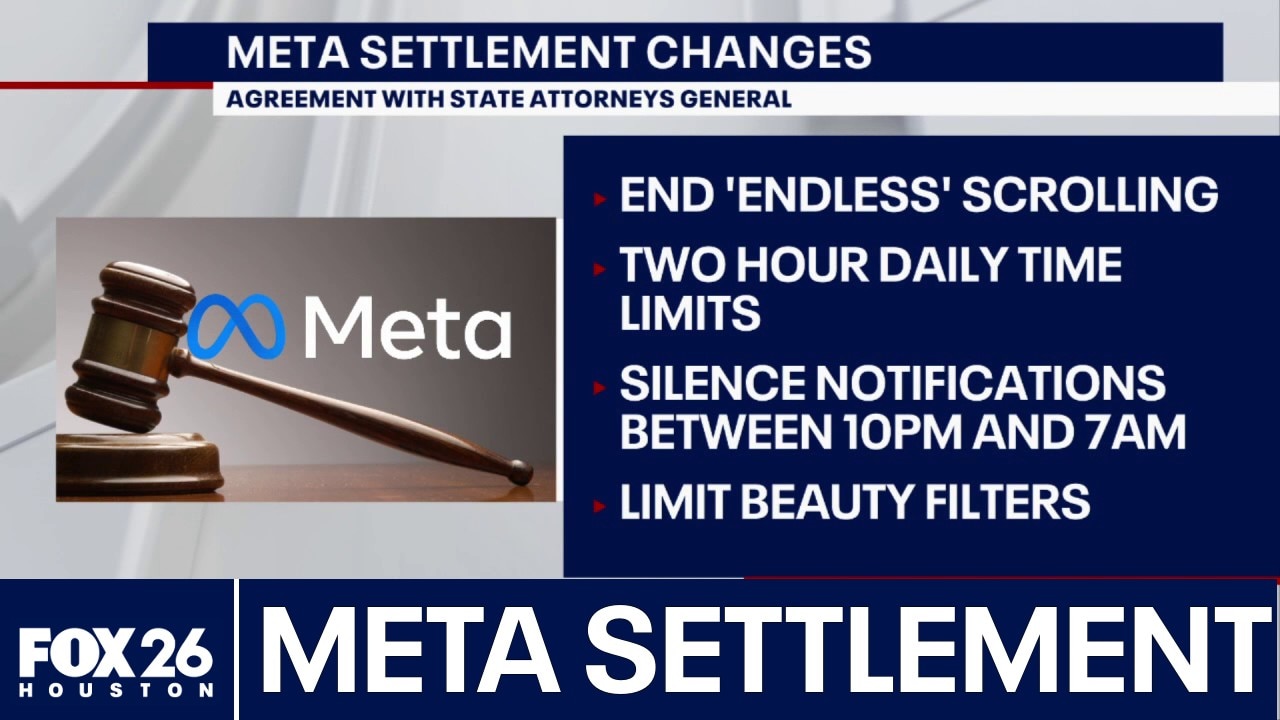
Meta agrees to settlement with 47 states in lawsuits
Texas has secured a historic settlement worth over $1 billion from Meta Platforms Inc., requiring the social media giant to implement sweeping new safety features for young users on Facebook and Instagram, state officials announced Wednesday. FOX 26's Mekenna Earnhart has more.
HOUSTON - Texas has secured a historic settlement worth over $1 billion from Meta Platforms Inc., requiring the social media giant to implement sweeping new safety features for young users on Facebook and Instagram, state officials announced Wednesday.
What we know:
The agreement resolves allegations that Meta intentionally designed its platforms to be addictive to minors, permitted children under 13 on its apps, and failed to protect youth from harmful content or online predators.
While Meta has denied all allegations, the company agreed to a 10-year operational framework aimed at establishing a new industry standard.
"This is a historic settlement and a major win for the safety of Texas children," Attorney General Ken Paxton said in a statement. "Not only will Meta pay over $1 billion to Texas, but the company will also implement significant new safety features to better protect children’s precious minds and well-being on its platforms."
Paxton emphasized that the agreement forms part of a broader push to reform tech safety standards.
"It is my mission to fundamentally change and strengthen the standards for child safety online, and this settlement is a major step forward in the fight to ensure our kids are protected online," Paxton said.
Mandatory guardrails for teen accounts
Why you should care:
Under the settlement, Meta will be required to roll out several mandatory guardrails for teen accounts, including:
- Screen-time limits: A default daily limit of two hours for teenage users.
- Notification silences: Disabling push notifications by default during school hours and restricting them through a designated nighttime access mode.
- Social comparison controls: Hiding public "likes" and reactions on posts by default.
- Age verification: Enforcing stricter age-assurance measures while continuing to limit age-inappropriate content.
The settlement money paid to the State of Texas will fund remediation efforts across the state, including youth mental health services, crisis resources, digital literacy programs, after-school initiatives, and grants for Texas schools.
Company's commitment to empowering parents
What they're saying:
In an official statement responding to the agreement, Meta Chief Legal Officer C.J. Mahoney highlighted the company's commitment to empowering parents through the new features, while pressing competing platforms to take identical action.
"I'm pleased to announce that Meta has reached an agreement with a bipartisan group of state attorneys general from around the country on a new set of rules governing teens' use of social media," Mahoney said. "The framework we've negotiated will empower parents to easily manage how their children access our platforms. Our new Time Limit commitments, Night Mode features and usage limits during school hours set the right path forward for our whole industry, but this framework will only work if all our peers join us. Because teens move fluidly across dozens of apps, we need an industry-wide solution. We therefore call on our industry peers, TikTok and YouTube, to implement this new framework, right away."
Kevin Martin, Head of Global Policy for Meta, also praised state leadership: "We want to thank Attorney General Ken Paxton for his leadership in protecting Texas teens and making this standard possible."
Despite the new guardrails, local child advocates caution that screen-time caps solve only part of the threat facing young users online.
Scrolling addiction vs physical safety risks
Local perspective:
Rania Mankarious, CEO of Crime Stoppers of Houston, explained that parents must distinguish between scrolling addiction and physical safety risks.
"There is the fear of our child becoming addicted to the platform, spending too much time to the point that it's developmentally unhealthy, that they are not sleeping enough, that it becomes obsessive," Mankarious said. "And when you can set a two-hour time limit, certainly that addresses that issue and helps a child. When it comes to worrying about who a child can talk to and what a child sees, we have to understand that within five minutes on any platform, a child can almost see anything and talk to anyone anywhere about any topic he or she may be interested in."
Mankarious noted that Crime Stoppers of Houston will continue its work independent of federal court approvals or legislative action.
"We are on a mission to reach 10 million kids for safety in the state of Texas, of course, starting with our home base in Houston, talking to kids K through 12th grade about every single digital issue that arises," Mankarious said, noting that nearly 50% of teens report feeling social media has become harmful to them. "And we will do that regardless of what is going on legislatively. This is our job, this is our requirement."
Mankarious stressed that protecting young users cannot rely solely on platform algorithms or young brains resisting design engineering.
"At the end of the day, we can't expect a 12-year-old brain to constantly succumb to the masterful engineering of these platforms," Mankarious said. "The burden falls on all of us... Parents and Crime Stoppers and legislative bodies and law enforcement and teachers and faculty and all of us have to be working together to educate and educate and talk about the issues."
Looking ahead to state policy efforts, Mankarious urged parents to stay engaged, pointing to an upcoming Sept. 15 special legislative hearing in Texas regarding social media grievances.
"I would encourage parents to not be afraid or ashamed to share their stories," Mankarious said. "I think a lot of parents go through real issues... but those stories help create solutions, so we encourage everybody to get involved."
The Meta deal marks Paxton's third major technology settlement exceeding $1 billion, following a $1.4 billion facial recognition settlement with Meta and a $1.375 billion privacy settlement with Google. Paxton's office is also scheduled to go to trial against TikTok in fall 2026 as part of its ongoing online child safety litigation.
The Source: Rania Mankarious, CEO of Crime Stoppers of Houston, Official press release issued by Attorney General Ken Paxton, Official Response Statement from Meta Platforms, Inc.