

House votes to end penny production permanently: What to know

Breaking down the history of the penny
Treasury Secretary Scott Bessent minted the last five U.S. pennies, each featuring a rare omega mark, officially ending penny production.
WASHINGTON - The House of Representatives voted Monday to pass legislation that would effectively end production of the penny and establish new rules for rounding cash transactions to the nearest 5 cents.
House votes to end production of penny
Big picture view:
The bipartisan Common Cents Act, led by House Republican Conference Chair Lisa McClain, R-Mich., and Rep. Robert Garcia, D-Calif., would prohibit the Treasury Department from producing additional pennies, except for collector coins. Existing pennies would remain legal tender.
The legislation also would establish a framework for rounding cash transactions to the nearest nickel when exact change cannot be provided. Cash wage payments would receive separate treatment: if an employer chooses to round a cash payment that is not divisible by 5 cents, it must round the amount up to the nearest 5 cents.
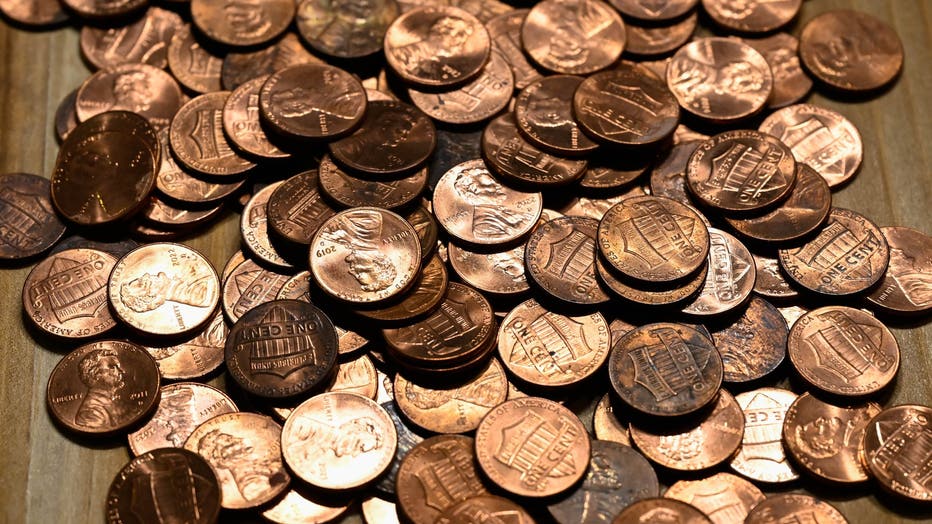
The legislation cites the high cost of producing pennies. (Credit: Getty Images)
The bill also would authorize the Treasury to adopt a lower-cost composition for the nickel, subject to testing for cost savings and compatibility with coin-operated machines.
The legislation also would require the Federal Reserve Board to report on penny distribution and coin-terminal operations, incorporating a Treasury assessment of the effects on low-income communities, older consumers and unbanked or underbanked people.
US Mint ends production of pennies in 2025
The backstory:
The Common Cents Act builds on earlier legislation sponsored by McClain that sought to end penny production but did not include provisions addressing cash rounding.
RELATED: Check your piggy bank - You may have a rare 1969 penny worth up to $600,000
The U.S. Mint ended its 232-year run of producing pennies for circulation in November 2025 after the Treasury Department determined that producing the penny was no longer economically sustainable.
The Treasury said the cost of producing a penny had risen to 3.69 cents, more than three times its face value, and projected $56 million in immediate annual savings from reduced material costs.
What they're saying:
"Let's rip the waste out of our great nation's budget, even if it's a penny at a time," President Donald Trump wrote on Truth Social last year.
It takes 3.7 cents to make a penny
Dig deeper:
The government says that the problem with pennies is they are issued, given as change, and rarely recirculated back into the economy. This requires the Mint to produce significant sums of pennies each year.
Pennies, especially in bulk, are also heavy. The Mint spent nearly 3.7 cents to make a penny in 2024, according to its most recent annual report.
RELATED: Paying in cash? Why retailers are asking for exact change
The Mint issued 3.2 billion pennies in 2024, the last full year of production, more than double that of the second-most minted coin in the country: the quarter.
The future of the penny
What's next:
The Treasury had previously estimated that roughly 114 billion pennies remain in circulation, although the Mint later estimated the number at about 300 billion. Pennies would retain their nominal value and remain legal tender indefinitely.
If enacted, the measure would codify the end of circulating penny production in federal law.
For consumers, the change would apply primarily to cash purchases.
The Source: The information for this story was provided by FOX News, Reuters, previous FOX Local reporting. This story was reported from Los Angeles.