

Talarico vs. Paxton: How the candidates differ on schools and education
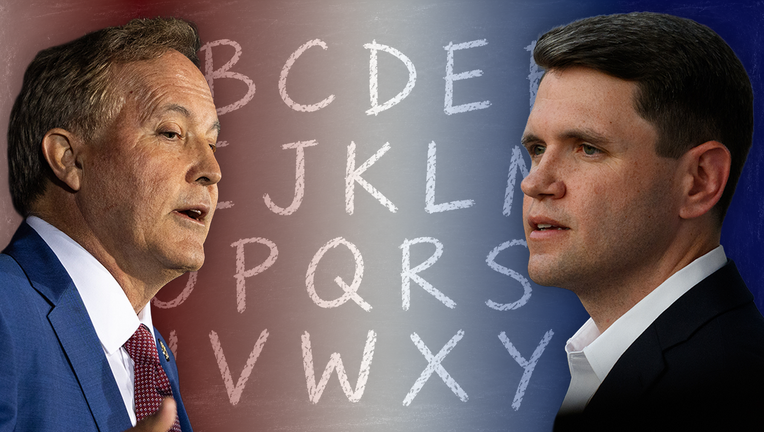
Education policy is one of the areas where James Talarico and Ken Paxton have the clearest differences. The two Texas Senate candidates have taken opposing positions on school vouchers, religion in public schools, higher education costs, diversity programs and school library restrictions. Here’s where they stand.
Talarico, a former public school teacher, has fought against school vouchers, book bans and the dissolution of the Texas DREAM Act while a member of the Texas House. Paxton, on the other hand, has used his status as the state's attorney general to defend the state's voucher program, coordinate a deal with the federal government over the DREAM Act and defended the state's requirement that book publishers provide ratings for their titles based on content.
School vouchers
While traditionally seen as a state-level discussion, the One Big Beautiful Bill Act will bring school vouchers to the national stage with the Educational Choice for Children Act.
In the Texas House, Talarico voted against school vouchers for Texas and said that using taxpayer dollars for private schools would hurt public schools and public school students. He argued that the program would just subsidize private tuition for families that were already enrolled in private schools.
Texas' school choice bill was passed last year and approved the use of $1 billion in taxpayer funds to establish education savings accounts. The program was rolled out in time for the 2026–2027 school year. During the debate over the bill, Talarico introduced an amendment that would have put the measure on the ballot for voters to decide.
The other side:
Paxton has worked to defend Texas' voucher program. He used his power as attorney general to file lawsuits against school districts when superintendents and school boards started talking about the impact that school vouchers would have on the district, citing the Texas election code that bans using public resources to influence an election.
Paxton has argued that school voucher programs empower parents to make the best choices for their children and that providing assistance directly to families does not diminish the public school system.
Ten Commandments and religion in schools
Talarico has called the decision to require posters of the Ten Commandments in Texas public schools an "un-Christian decision" that poses an affront to those following other religions in Texas. Even though Talarico is a Presbyterian seminarian, he said he did not want "the government forcing a religion down my throat."
The other side:
Paxton defended the law in federal court, including the Fifth Circuit Court of Appeals, which ruled the law was constitutional and allowed it to take effect.
He called the court's decision a "major victory for Texas and our moral values" and said the attorney general's office was "proud to defend" the law.
Talarico has also come out against the Bluebonnet curriculum, and its inclusion of biblical texts in public schools.
"When you're talking about religion, when you're talking about faith, when you're talking about theology, you're working with fire," Talarico said to Texas Education Agency commissioner Mike Morath during a 2024 House Committee on Public Education meeting.
Paxton, on the other hand, wrote an order to the State Board of Education requiring the board to identify "the essential knowledge and skills for religious literature."
Higher education costs, expression
Talarico and Paxton have differing opinions on who should be allowed to pay in-state tuition in Texas, how college loan debt should be repaid and how college and university hiring practices should be handled.
In June 2025, the federal government sued Texas over its law that allowed undocumented migrants that attended high school in Texas to attend a state-funded college or university by being classified as a state resident for tuition purposes.
The lawsuit was met with a settlement agreement by Paxton's attorney general's office that same day, ending the program. Attempts to challenge the settlement have been denied in federal court.
The Texas DREAM Act had long been a target of Republicans in the state legislature, despite being passed with bipartisan support and signed by Republican Gov. Rick Perry.
Talarico had opposed legislative attempts to repeal the law, saying that students who attended public schools in the state should not be priced out of higher education.
The two also differ on what should happen to those who went to college and amassed student loan debt.
Talarico supports student debt relief, arguing that cumulative debt prevents young people from buying homes and building wealth.
He's also advocated for expanding the value of federal Pell Grants, indexing them to inflation to reduce the need for lower-income students to borrow funds.
Paxton has been a part of litigation against federal student loan forgiveness, including being part of a multi-state effort to block then-President Joe Biden's student debt cancellation plan and working to block the SAVE Act.
He believes student loan forgiveness programs force non-degreed, blue-collar taxpayers to subsidize the debts of those who went to college.
The two have also failed to see eye-to-eye on diversity, equity and inclusion initiatives.
Paxton has helped enforce compliance with Texas laws that eliminated diversity, equity and inclusion offices, diversity statements and mandatory identity training at all public universities. Saying their elimination ensures hiring is merit-based.
Talarico believes the elimination of those programs makes college harder for first-generation and underrepresented students. He also says the removal of those programs will damage the research prestige of state schools and hurt the recruitment of top talent.
School libraries
Texas led the nation in books banned from school libraries last year. School districts have been threatened with have their educational scores lowered if school libraries do not comply with a state law that puts the decision to remove a book in the school board's hands instead of school librarians.
Senate Bill 13, passed in 2025, allows for the creation of local school advisory councils to "assist the district in ensuring that local community values are reflected in each school library catalog in the district."
During discussion of the bill, Talarico said it could lead to small groups of people limiting students' access to books.
"If your answer to ‘could Romeo and Juliet be banned,’ if it is anything other than ‘of course not,’ then that is a serious problem," Talarico said in 2025.
Paxton, who was attorney general at the time, did not directly weigh in on SB13, but has signaled support for parental majority library councils and expanded parental notifications.
Paxton also defended Texas' READER Act, which would have required publishers to give ratings to their books. The law was declared unconstitutional in 2025.
Talarico voted against the READER Act, saying the bill could lead to classic literature being banned.
The Source: Information in this article comes from the Talarico campaign, comments made during Texas legislative meetings, and comments made by Paxton about state litigation. The Paxton campaign did not directly respond to our request.