

NASA Mars rover finds ‘honeycomb’ patterns on red planet

Mars rover Curiosity celebrates 10 years
Mars rover Curiosity has been exploring the Red Planet for a decade (Credit: NASA)
NASA's Curiosity Mars rover has uncovered an unexplained discovery – the largest field of honeycomb-like rock fractures seen during its mission on Mars.
Researchers say the findings could provide new clues about the planet's geologic history and ancient environment.
NASA Mars rover spots ‘honeycomb’ patterns on planet
Big picture view:
As NASA’s Curiosity rover recently began climbing up a Martian valley nicknamed "Valle Grande," it sent back images that were a familiar sight to mission scientists: honeycomb-like textures called polygonal fractures, each one about 1.5 to 3 inches across.
The discovery was revealed through a 360-degree panorama captured on June 19 and 20, showing the polygon-shaped cracks blanketing the landscape and even wrapping around the sides of a 20-foot-tall butte nicknamed "Miraflores."
What they're saying:
"We’ve seen a lot of fascinating landscapes through Curiosity’s eyes, but this sea of polygons took our breath away," the mission’s project scientist, Ashwin Vasavada of NASA’s Jet Propulsion Laboratory in Southern California, said in a statement. "We measured their shapes and chemistry carefully and are hopeful there are clues in the data as to how these features formed."
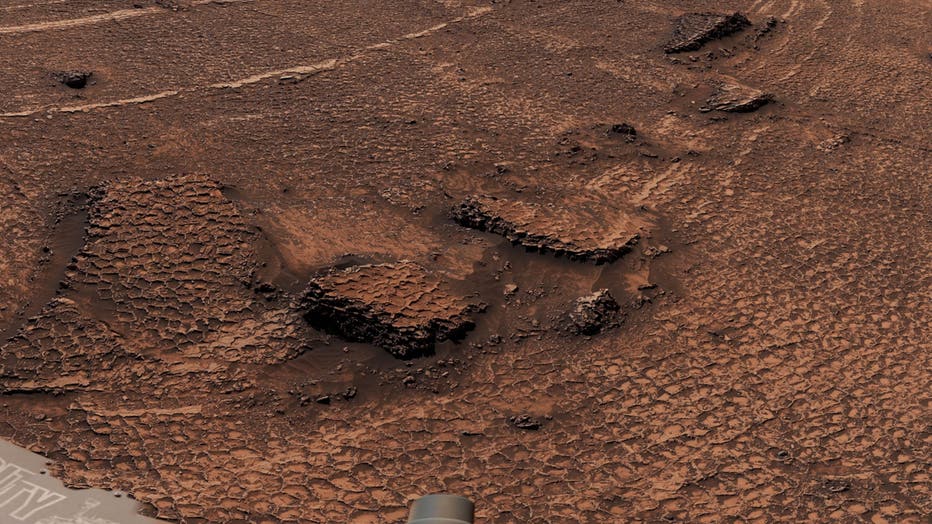
A close-up of the polygon fractures discovered by NASA’s Curiosity Mars rover highlights their honeycomb-like textures(Credit: NASA/JPL-Caltech/MSSS)
Scientists believe some similar formations previously observed by Curiosity were created as mud cracks formed when wet sediment dried. However, researchers say several geological processes could produce the distinctive honeycomb textures, including repeated cycles of heating and cooling or pressure that squeezed water out of the sediment when the surface was buried.
Discovery adds to list of other findings by Curiousity
The backstory:
The latest find adds to a growing list of discoveries made by Curiosity since it landed on the Red Planet in August 2012.
During its journey, the rover has uncovered sulfur crystals, iron-rich meteorites and a wealth of geological evidence revealing that Mars was once a much wetter world.
"Besides sulfur crystals, shiny meteorites, and other interesting geologic features, the rover has made major discoveries about the ancient Martian environment — most importantly, that it had the water, chemistry, and nutrients to support microbial life," NASA wrote in its update on Wednesday.
RELATED: Life on Mars: What we know after NASA's announcement
Curiosity has spent more than a decade climbing the lower slopes of Mount Sharp, a 3-mile-high mountain that scientists believe preserves layers of Martian history.
The rover has previously uncovered chemistry left over from Mars’ watery history, including carbon-based molecules believed to be precursors to RNA and DNA, two nucleic acids that carry genetic information. Scientists have no way of knowing whether these organic molecules were created by biologic or geologic processes — either path is possible — but their discovery reconfirmed that ancient Mars had the right chemistry to support life.
The Source: The information for this story was provided by NASA. This story was reported from Los Angeles.