

California labor leader Dolores Huerta dies at 96
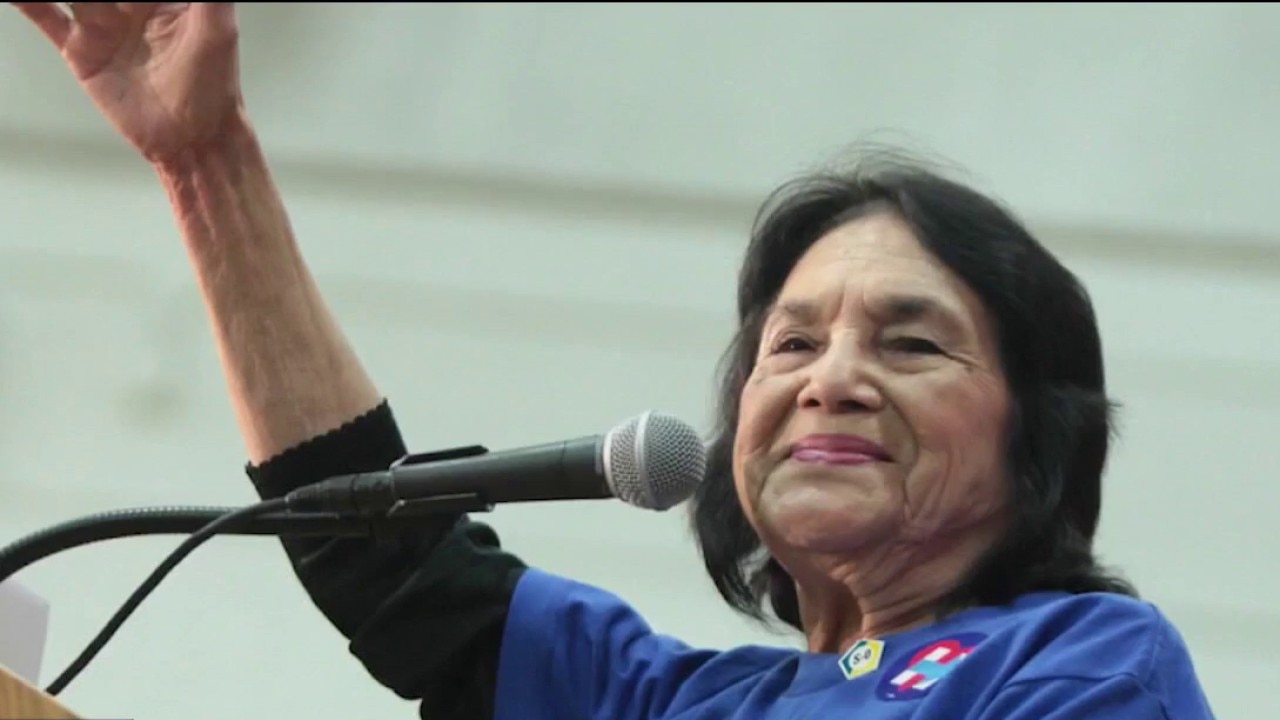
Dolores Huerta dies at 96
Dolores Huerta, one of the country's most influential labor activists and co-founder of the National Farm Workers Association, has died, her family announced on Wednesday.
BAKERSFIELD, Calif. - California's iconic labor leader, Dolores Huerta, has died at the age of 96, her family said on Wednesday, leaving behind a legacy of community activism that her protégés say should last on because of how she led and trained them.
Dolores Huerta dies at 96
What they're saying:
"As you can imagine, this is an incredibly difficult time for us, and we ask for privacy as we grieve this incredible loss to our family," her family said in a statement. "We know that many of you around the world share in our mourning, and we will be following up on plans to recognize and celebrate her incredible life and legacy."
Co-founder of UFW
Dig deeper:

Cesar Chavez accused of sexually abusing 2 girls and Dolores Huerta
Dolores Huerta, 96, announced Wednesday that she was sexually abused and impregnated twice by Cesar Chavez, her boss and co-founder of the organization that became the United Farm Workers union. Her statement comes after a New York Times investigative report about two women, Ana Murguia and Debra Rojas, who said Chavez sexually abused them when they were 12 and 13 years old, between 1972 and 1977.
As co-founder of what eventually became the United Farm Workers union, Huerta was the face of a movement that for decades aimed to empower the lives of workers through higher wages, health benefits, pensions and improved safety.
She was among those who joined Filipino grape pickers on the picket line in what became the five-year "Delano Grape Strike" and helped negotiate collective bargaining agreements and contracts with big growers, winning the first health and benefit plans for farmworkers.
She founded the UFW with the late César Chávez, and in March, she accused him of sex allegations, impregnating her twice.
At the time, Huerta told news outlets that she felt she couldn't stay silent any longer. Chavez died in 1993.
Almost immediately, municipalities across the country began renaming buildings and streets for Huerta, taking down the Chavez name.
Her admirers said they will miss her, but her legacy will remain.
"As I went through adulthood, she was always there," Andres Quintero, political science professor at Evergreen Valley College in San Jose, told KTVU. "Always active, if there was a cause, you could always rely on her."
Quintero called her a "trailblazer in her own right," supporting the wider community with a special focus on Latino farmworkers and women.
"She has left behind a legacy of individuals…who can now carry out her work," Quintero said.
California Sen. Maria Elena Durazo said her friend was active until the very end.
"A few months ago, she was dancing at a foundation fundraiser," Durazo said. "She was dancing. She was having a great time."
Durazo added that Huerta may have been a bit slower than normal, but "she had a big smile on her face. She was surrounded by people she loved and she respected."
Huerta's legacy
Big picture view:

KTVU archives: Interview with Dolores Huerta on Nov. 9, 1987
California labor leader Dolores Huerta and Wayne Smith, of Alien Legalization for Agriculture, join KTVU on Nov. 9, 1987.
Huerta was born in 1930 in Dawson, New Mexico to a union-organizer father and an independent businesswoman mother.
Huerta grew up and went to school in Stockton, Calif., where she experienced and witnessed injustices, prompting her to develop a passion for helping others as she knew to create change meant organizing and using her voice, according to the Dolores Huerta Research Center for the Americas.
Huerta had been an activist for multiple marginalized communities and through her many years of organizing, she famously coined the term Sí, se suede, which President Obama used in the English version as "Yes, we can."
When she began to organize farmworkers, she also became passionate about women’s rights.
Seeing women being mistreated in the fields and other workplaces made her become an ardent feminist leader, as well.
Before she was known as the only woman in the UFW board, she was a community organizer in Stockton, including getting people out to vote, according to the research center.
Huerta had been awarded many honorary doctorates, medals, and awards, including the 2011 Presidential Medal of Freedom recipient, the highest civilian honor in the United States.
She kept a busy schedule well into her 90s, marching in protests and speaking in cities across the country about race, poverty, LGBTQ+ and women’s rights on behalf of her Bakersfield, California-based foundation.
When Obama presented the award in 2012, he praised Huerta as a tenacious leader and joked that he had stolen her slogan for his 2008 campaign.
The Source: Information for this story comes from Dolores Huerta's family, professor Andres Quintero, California Sen. Maria Elena Durazo, the Dolores Huerta Research Center for the Americas and the Associated Press.